

Canon EOS R6 Mark III vs Canon EOS R6 V
The Complete Guide to Choosing the Right Camera for You
There’s a moment every camera buyer eventually faces, two products from the same brand, built around the same sensor, priced within a few hundred dollars / rupees of each other, and yet designed for almost completely different lives behind the camera. That’s exactly where Canon has placed the EOS R6 Mark III and the EOS R6 V.
On paper, they look like siblings, maybe even twins.
Both use a 32.5-megapixel full frame sensor. Both are powered by Canon’s DIGIC X processor. Both can shoot 7K video. Both carry the R6 name, which for years has meant, the sensible, do everything, full frame Canon camera that isn’t trying to bankrupt you like the R5 or R1.
But spend a week with each one, and you realise Canon didn’t build two versions of the same camera. It built one camera for people who take pictures and sometimes shoot video, and another for people who shoot video and sometimes take pictures. That distinction subtle on a spec sheet, massive in real life is what this entire article is about.
We’re going to go deep. Sensor technology, autofocus behaviour, viewfinder design, ergonomics, video architecture, battery life, card slots, and because so many people are curious exactly what it’s like to actually pick up the EOS R6 V and shoot photos with it, even though it wasn’t really built for that job. By the end, you should know, with real confidence, which camera belongs in your hands.
Buy the Canon EOS R6 Mark III, if you’re primarily a photographer for weddings, portraits, events, sports, wildlife, travel, family life and you want video to be a strong bonus feature rather than the main event. You want an electronic viewfinder, a mechanical shutter, and a camera that feels like a real camera in the traditional sense.
Buy the canon EOS R6 V, if you’re a content creator, vlogger, documentary shooter, podcaster, or run and gun videographer who lives behind a screen rather than a viewfinder, who values longer recording times and active cooling over an eye level finder, and who occasionally needs great stills but isn’t shooting a wedding gallery with this camera as the primary body.
Now let’s unpack why :
1. The Shared DNA : Both have Same Sensor, Same Brain, but different body.
Both cameras are built around a new 32.5-megapixel full-frame CMOS sensor, the first time this particular sensor has appeared in Canon’s mainstream mirrorless lineup, having previously debuted in the cinema oriented EOS C50. It’s paired with the DIGIC X image processor in both cameras, which means at the level of raw image forming hardware, the R6 Mark III and R6 V are extremely close relatives.
This matters enormously for buyers, because it means neither camera is meaningfully better in resolution, dynamic range, or colour science than the other. If you shot the same RAW file side by side from both bodies under identical light, you would struggle to tell them apart. Canon didn’t nerf the sensor in the video focused model, and it didn’t give the photo focused model some secret imaging advantage. The differentiation lives almost entirely in the body, the controls, the viewfinder, the cooling system, and the shooting philosophy, not in image quality at the pixel level.
Both cameras also inherit Canon’s Dual Pixel CMOS AF II system, subject recognition for people, animals, and vehicles, and Canon’s latest in-body image stabilization architecture. So don’t go into this comparison expecting one camera to autofocus dramatically better than the other in good light, they largely share the same autofocus brain. Where they diverge is everything wrapped around that brain.
2. Design Philosophy – A camera Vs A Filmmaking Tool,
This is the heart of the comparison, so let’s spend real time here.
The EOS R6 Mark III, A traditional Mirrorless Camera,
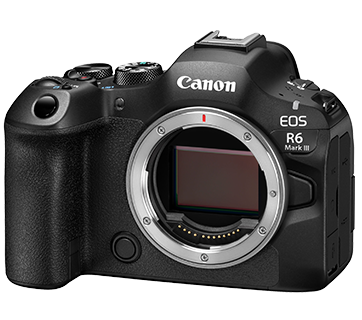
The R6 Mark III looks and feels like every serious mirrorless camera you’ve picked up in the last five years. It has a pronounced grip, a mode dial, a joystick for AF point selection, dual control dials, and critically a proper electronic viewfinder with 3.69- million dots and 0.76x magnification sitting front and centre on the top plate. You bring it to your eye, you compose, you shoot. It has a mechanical shutter capable of 12 fps, alongside a blackout-free electronic shutter mode that reaches an extraordinary 40 fps for stills. It takes both CFexpress Type B and SD cards, giving photographers flexibility between speed and cost.
Everything about the body language of the R6 Mark III says: this is a camera first. Video is a phenomenally capable secondary skill 7K RAW internal recording, 4K oversampled at 60p, even 1080p at 180fps for slow motion but the physical design never stops assuming you’re a photographer who occasionally rolls video, rather than the other way around.
The EOS R6 V : A Video Tool Wearing a Camera’s Skin,
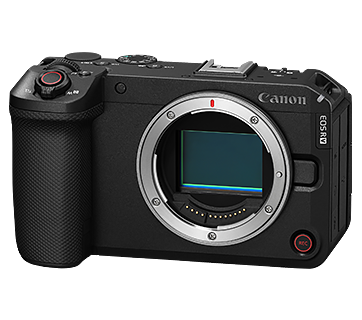
The R6 V throws out several assumptions the R6 Mark III keeps. There is no electronic viewfinder. There is no mechanical shutter. The top plate is flatter and boxier, designed to sit comfortably on a gimbal rather than to house a viewfinder hump. It has a front-facing record button (so you can start recording while the camera faces you hello, vloggers), a top-plate record button with an integrated zoom lever for power-zoom lenses, a tally lamp so you know at a glance you’re rolling, and a full-size HDMI terminal rather than a micro-HDMI port that snaps off if you look at it wrong.
Perhaps the most telling detail: the R6 V has a built-in vertical tripod mount and a rotating interface specifically designed for vertical video, because Canon knows a meaningful percentage of this camera’s footage is headed straight to Instagram Reels, YouTube Shorts, and TikTok, not into a horizontal cinema timeline.
It also includes an active cooling fan, something the R6 Mark III doesn’t have. That fan exists for one reason: to let the R6 V record demanding formats like 7K 60p RAW for far longer than a fan-less body safely could before overheating. Canon built this camera assuming you might record for an hour, not eight minutes.
In short: the R6 Mark III was designed by engineers thinking about photographers who shoot video. The R6 V was designed by engineers thinking about videographers who occasionally shoot stills.
3. The Viewfinder Question : Why it matters more thank you would think,
Let’s talk about the single biggest usability difference between these two cameras: the R6 V has no electronic viewfinder at all.
For a huge portion of video creators, this genuinely doesn’t matter. If you’re vlogging, filming a podcast, mounting the camera on a gimbal, or shooting from a tripod while looking at a flip-out screen, an EVF is dead weight literally and figuratively. Removing it lets Canon make the body more compact, put the weight budget elsewhere (like that cooling fan), and build a flatter top plate that’s friendlier to rigs and gimbal mounts.
But for photographers, the EVF isn’t a nice-to-have it’s often central to how you shoot. Bright outdoor light where an LCD screen washes out. Sports and wildlife where you need to track a moving subject with your eye pressed to the finder for stability and precision. The simple ergonomic comfort of bracing a camera against your face rather than holding it at arm’s length. Street and documentary photographers often prefer the discretion of an EVF over holding a glowing screen up in someone’s face.
This is why the R6 Mark III retains a proper EVF and the R6 V doesn’t. Canon isn’t being lazy or cutting corners to save money, it’s making a very deliberate statement about who each camera is for. If eye-level shooting matters to you at all, this one fact alone should end the debate in the R6 Mark III’s favour.
4. Mechanical Vs No Mechanical Shutter
The R6 Mark III has both a mechanical shutter (up to 12 fps) and an electronic shutter (up to 40 fps). The R6 V drops the mechanical shutter entirely and shoots stills purely electronically.
Why does this matter? A few reasons:
Flash Sync :
Mechanical shutters sync reliably with flash at speeds like 1/200s or so. Purely electronic shutters generally can’t sync at anything faster than around 1/60s, because of how the sensor is read out line by line. If you shoot with studio strobes, speed-lights, or off-camera flash regularly, for portraits, product photography, or events, this is a real limitation on the R6 V, not a theoretical one.
Rolling Shutter distortion :
Because the R6 V’s sensor isn’t a stacked design, fast-moving subjects or quick camera pans can produce a “jello” or skewed effect in stills and video, since the sensor is scanned progressively rather than all at once. Canon has optimised the readout speed to minimise this, and in practice it’s rarely a dealbreaker, but it’s a real trade- off worth knowing about if you shoot fast action.
Longevity concerns some photographers have,
Mechanical shutters are rated for a certain number of actuations before wear becomes a factor (though modern shutters last a very long time).
Electronic-only shooting sidesteps this entirely, which is arguably an advantage for high-volume shooters , just one that comes bundled with the sync and rolling-shutter trade-offs above.
For most video-first creators, none of this matters. For photographers who occasionally use flash or shoot fast sports and wildlife, it matters quite a bit.
5. Autofocus : nearly identical, but context changes everything.
Both cameras use Canon’s excellent Dual Pixel CMOS AF II system with the same subject-detection smarts: people (including a “Register People Priority” feature that lets the camera prioritise specific individuals it has learned to recognise), animals, vehicles, and more. Autofocus area modes, single point, point expansion, flexible zone, whole-area tracking, and face tracking are shared across both bodies.
In good light, tracking a person, a dog, a car, or a bird will feel essentially the same on either camera, because the underlying autofocus engine and processor are the same. The lowest-light autofocus threshold, when using an f/1.2 lens with the centre AF point in One-Shot mode, is rated the same way on both. Canon hasn’t crippled AF sensitivity on the R6 V.
What changes is how you interact with that autofocus. On the R6 Mark III, you’re often selecting AF points via a joystick while looking through the viewfinder, making split-second adjustments with your eye still on the subject. On the R6 V, you’re almost always touching the screen or letting subject tracking do the work, because there’s no eye-level finder to use a joystick with in the same intuitive way. For fast reaction photography, a soccer match, a bird taking flight, a candid moment at a wedding, the viewfinder-driven workflow of the R6 Mark III tends to feel faster and more natural in the hands of an experienced shooter.
6. Continuous Shooting and Buffer –
Both cameras can shoot stills at up to 40 fps using the electronic shutter, with pre-continuous shooting (capturing roughly half a second of frames before you fully press the shutter button , genuinely useful for unpredictable action like a bird launching off a branch). The R6 Mark III adds a 12 fps mechanical shutter option for photographers who want or need it.
In burst shooting terms, they’re closely matched. The practical difference again comes back to how comfortable and controlled it feels to track a subject through a viewfinder versus a screen while firing off 40 frames per second and that favours the R6 Mark III for dedicated action photography.
7. Video – Where the R6 V pulls ahead,
Let’s flip the lens now, because this is the R6 V’s home turf.
Both cameras can record 7K RAW internally at up to 60p, and both support 7K 30p “open gate” recording (using the entire width and height of the sensor, which is enormously useful if you plan to reframe footage later for both horizontal and vertical delivery, think YouTube long-form and Instagram Reels cut from the same take). Both offer 4K oversampled recording, high frame-rate 4K up to 120p for slow motion, and Canon Log 2 and 3 colour profiles for maximum dynamic range and grading flexibility.
So why would anyone choose the R6 V for video over the R6 Mark III, if the recording specs are so similar ?
Sustained recording time: This is the big one. The R6 V’s active cooling fan lets it record demanding, high bitrate formats like 7K 60p RAW for meaningfully longer stretches before thermal shutdown becomes a concern. The R6 Mark III, without a fan, is more likely to hit thermal limits during long, intensive recording sessions, a real issue if you’re shooting an hour-long interview, a livestream, or a lengthy event in RAW.
Ergonomics built for video work-
he front record button means you can start rolling while facing the lens essential for solo creators who step in front of their own camera. The power-zoom lever, the tally lamp, the full-size HDMI port, and the vertical shooting UI are all quality of life features that a photographer would rarely miss, but that a working videographer uses constantly.
Form factor for rigs and gimbals-
The flatter top plate (no EVF hump) makes the R6 V noticeably friendlier to cages, gimbals, and shoulder rigs. If your workflow involves handheld gimbal work, a very common setup for run-and-gun documentary and social content, this body shape is a genuine advantage, not just an aesthetic choice.
In-Body stabilisation tuned for handheld video-
Canon specifically markets the R6 V’s IS system as delivering exceptionally smooth handheld footage up to roughly 7.5 stops of correction with compatible lenses pitched explicitly as an alternative to needing a gimbal at all for many shots.
If your work is 80% video and 20% stills, the R6 V is doing exactly what it was built to do, and doing it better than the R6 Mark III in the specific ways that matter to a working videographer.
8. What if a photographer actually shoots stills on EOS R6 V ?
This is a question a lot of people are genuinely curious about, so let’s answer it honestly and in detail, because the R6 V is not a bad stills camera , it’s a fantastic stills camera that happens to be missing a couple of photographer-centric conveniences.
Image quality :
Identical to the R6 Mark III at the sensor level. You’re getting the same 32.5-megapixel full-frame files, the same colour science, the same dynamic range, the same high-ISO performance. If your test is “how does the photo look,” the R6 V will not disappoint you at all. Portraits, landscapes, travel photography, even casual street work will look every bit as good as they would coming out of the R6 Mark III.
Composing without a viewfinder :
This is the biggest adjustment. You’ll be composing on the rear touchscreen, which is bright and detailed, but shooting at arm’s length changes your relationship with the frame. In bright daylight, screens are harder to read than an EVF, and you lose the physical stability of bracing the camera against your face handheld shots at slower shutter speeds can be a touch less steady as a result, even with strong in-body stabilization helping to compensate.
Fast action and sports :
You can absolutely shoot fast bursts at 40 fps and let Canon’s subject tracking do the heavy lifting, and it’s genuinely very good at locking onto people, animals, and vehicles automatically. But manually adjusting an AF point on the fly, mid-sequence, without a viewfinder and joystick, is less intuitive than it is on the R6 Mark III. If you shoot fast, chaotic sports or wildlife where you need to make split-second AF adjustments, you’ll feel the absence more here than anywhere else.
Flash Photography :
Because there’s no mechanical shutter, sync speed is capped around 1/60s. Casual on-camera flash for events or indoor gatherings will be fine. Serious studio strobe work, high speed sync portraiture, or freezing motion with flash outdoors in bright light becomes considerably more limited.
Handling and grip during a long stills shoot:
The R6 V’s flatter, boxier design is optimised for gimbal and rig use, which means it’s slightly less naturally ergonomic for hours of handheld stills shooting compared to the R6 Mark III’s more traditional, photographer-tuned grip and control layout.
The honest verdict for photographers considering the R6 V :
if you occasionally need excellent stills alongside video-first work , a videographer who also needs to deliver a gallery of behind-the-scenes photos, a content creator who posts both video and photo content, a documentary shooter capturing stills between takes, the R6 V will serve you beautifully. But if stills are your primary output and video is secondary, you will consistently miss the viewfinder, the mechanical shutter, and the more tactile AF controls that the R6 Mark III offers as standard.
9. Build, Ports, and Everyday Practicalities
The R6 Mark III accepts both CFexpress Type B and SD cards, giving photographers flexibility ,SD for everyday shooting, CFexpress when you need to sustain very high frame rates or high-bitrate RAW video without buffer slowdowns. Battery life on the R6 Mark III is rated at roughly 620 shots using the LCD and about 390 through the viewfinder under CIPA testing standards, which is solid for a mirrorless camera in this class, though real-world numbers for photographers who chimp their screen less and shoot in bursts often run higher.
The R6 V, being newer and video centric, carries forward similar underlying storage flexibility and battery architecture, with additional attention paid to sustained power draw during long recording sessions, something the active cooling system and firmware are specifically tuned to support. Its full-size HDMI port (rather than the more fragile micro-HDMI connectors common on many mirrorless cameras) is a small but meaningful upgrade for anyone doing serious video work, since it’s far less prone to the loose-connection issues that plague micro-HDMI in professional environments.
10. Price :
How much are we talking about ?
The Canon EOS R6 Mark III launched at $2,799 body only in the US and in India at Rs. 2,43,995.00, a $300 increase over its predecessor, the R6 Mark II, but in line with what buyers should expect from a meaningfully upgraded sensor and feature set. Kit options bundling various RF lenses push the price up from there, into the $3,100–$4,050 range depending on the lens included.
The Canon EOS R6 V launched at a lower body-only price point, around $2,500 in US and in India its at Rs. 2,35,995.00, positioning it as a slightly more accessible entry into full-frame video- first shooting than the R6 Mark III, while still sitting above Canon’s APS-C-based EOS R50 V in the broader V-series lineup, and below the dedicated cinema cameras like the EOS C50.
So in practical terms, the R6 V isn’t just a different tool than the R6 Mark III — it’s also the marginally more affordable one, which makes sense given it omits the EVF and mechanical shutter mechanisms that add cost to the Mark III.
11. Side by Side Summary Table :
| Feature | Canon EOS R6 Mark III | Canon EOS R6 V |
| Sensor | 32.5MP full- frame CMOS | 32.5MP full- frame CMOS (same sensor family) |
| Processor | DIGIC X | DIGIC X |
| Viewfinder | 3.69M-dot OLED EVF, 0.76x | None |
| Shutter | Mechanical (12 fps) + Electronic (40 fps) | Electronic only (40 fps) |
| Flash sync | Standard mechanical sync speed | Capped around 1/60s (electronic only) |
| Video | 7K RAW 60p internal, 7K 30p open gate, 4K 120p | 7K RAW 60p internal, 7K 30p open gate, 4K 120p |
| Cooling | Passive (no fan) | Active cooling fan for extended recording |
| Body design | Traditional mirrorless, viewfinder hump | Flat top plate, gimbal-friendly, vertical tripod mount |
| Video- specific controls | Standard | Front record button, zoom lever, tally lamp, full-size HDMI |
| Card slots | CFexpress Type B + SD | SD-based storage (same general flexibility) |
| Price ( Body ) | MRP Rs. 2,43,995.00/U | MRP Rs. 2,35,995.00/U |
| Ideal User | Photographers who also shoot video | Videographers who also shoot stills |
| Source : | Canon India | Canon India |
12. Who should buy the Canon Eos R6 Mark III
You should lean toward the R6 Mark III if you recognise yourself in any of these descriptions:
The wedding and portrait photographer – You need the viewfinder for precise composition in changing light, reliable flash sync for off-camera lighting setups, and a camera that feels instinctive during eight hours of continuous, high-pressure shooting.
The sport and wildlife shooter :
You need the mechanical shutter option, the tactile joystick and viewfinder AF workflow, and the ergonomic grip built for long lenses and long days in the field.
The travel and street photographer :
You want the discretion of shooting through an eye-level finder rather than holding a screen up, and the comfort of a more traditional camera body for extended handheld use.
The Photo first hybrid creator :
If your income or passion is primarily photography and video is a valuable secondary skill for behind-the-scenes content, client add-ons, or personal projects, the R6 Mark III gives you genuinely excellent video specs without sacrificing anything on the photography side.
Anyone who simply prefers holding a camera the traditional way :
Some of this comes down to feel, and there’s nothing wrong with that. If an EVF and a mode dial feel like “a real camera” to you, that instinct is valid and worth honouring.
13. Who should buy the canon EOS R6V ?
Lean toward the R6 V if you see yourself here instead:
The YouTuber , vlogger, or solo content creator :
The front record button, the flip screen, the absence of an EVF you’d never use anyway, and the compact, gimbal ready form factor are built exactly for your daily workflow, including filming yourself.
The documentary and run and gun videographers :
Longer sustained recording thanks to active cooling, a body shaped for rigs and gimbals, and full-size HDMI for reliable external monitoring make this a serious professional video tool at a relatively accessible price.
The podcaster and live-streamer :
Reliable long duration recording, a tally lamp for on-air awareness, and strong autofocus for multi-person framing all matter more here than an optical or electronic viewfinder ever would.
The vertical video first creator :
With a built-in vertical tripod mount and a rotating vertical interface, the R6 V is arguably the most vertical video friendly full-frame camera Canon has ever released, a direct answer to how much content today is consumed on phones.
The hybrid creator whose stills are secondary :
If you need occasional, excellent photos alongside your primary video output, but photography isn’t your main deliverable, the R6 V’s stills quality will not let you down, even if the shooting experience is a little different from a dedicated photo body.
14. The Bigger Picture :
Why canon split the R6 line this way ?
It’s worth stepping back and appreciating what Canon is doing strategically. For years, camera manufacturers tried to build one camera that did everything reasonably well. Increasingly, brands like Canon, Sony, and Nikon are instead building deliberately specialised bodies around a shared sensor and processing platform, then trusting buyers to self-select based on how they actually work.
The R6 Mark III and R6 V are the clearest expression of that philosophy in Canon’s current lineup. Rather than compromising a single camera to serve both photographers and videographers only adequately, Canon built two cameras that each do their primary job exceptionally well, while remaining very capable at the “secondary” job most buyers will still occasionally need.
That’s genuinely good news for you as a buyer. It means you’re not choosing between “good” and “bad” — you’re choosing between “excellent at photography, very good at video” and “excellent at video, very good at photography.” Neither choice is a mistake. The only mistake is picking the one that doesn’t match how you actually spend your time behind the camera.
My Views :
If there’s one sentence to leave you with, it’s this:
The R6 Mark III and R6 V share a sensor, but they don’t share a purpose.
The Mark III is Canon quietly perfecting its formula for a photographer’s mirrorless camera that also happens to shoot phenomenal video. The R6 V is Canon building, almost from scratch, a video first full frame camera for a generation of creators who think in terms of frame rates, gimbals, and vertical crops as much as they think in terms of f-stops and shutter speed.
Ask yourself honestly:
when you imagine yourself using this camera next month, are you holding it up to your eye, tracking a subject through a viewfinder or are you glancing at a flip out screen, hitting record, and stepping in front of the lens yourself?
Whichever image comes to mind first is very likely your answer.
Either way, you’re buying into the same excellent sensor, the same dependable autofocus intelligence, and the same Canon colour science that has made the R6 series one of the most trusted names in full frame mirrorless photography.
The only real question left is which body was built for the way you shoot and now, hopefully, you know exactly which one that is.
